
Green-winged Teal, Anas crecca
Bill Rowe
You’re watching a wetland, trying to see the ducks hidden in the grass, when an eagle swoops over the area and flushes them all up, bigger ones like Mallard and Gadwall along with a dense flock of little Green-winged Teal, tied for “smallest American duck,” which rise and zip around together like shorebirds. The males, with their green-banded rufous heads, are more distinctive than the plain brown females, but the sexes do share the same wing pattern in flight (true of most ducks). Green-wings are common to abundant in the Midwest on their spring migration, which takes most of them beyond the “prairie pothole” wetlands where many of our waterfowl breed and on to the vast forested regions of Canada and Alaska. Coming back south in the fall, they are favorites of hunters, cited as the second-most numerous duck taken after the Mallard. Their winter range is roughly the southern and western U.S. and Mexico, with Missouri lying somewhere along the northern edge of it. In general, southern Missouri has a lot more wintering Green-wings than northern, but the actual numbers depend on the local climate and how frozen or open the water is. World-wide, there are two main forms of this bird, one North American and one Eurasian, almost the same in appearance but not quite (see below). Whether to classify them as subspecies or as two different full species has been a source of ongoing disagreement among ornithologists, but right now there is a tentative agreement to keep them “lumped” as the world-wide species Anas crecca, with our Green-wing continuing as subspecies carolinensis and the Eurasian bird as the “nominate” subspecies crecca, which shows up with some frequency in the U.S., mostly in coastal states but not necessarily right along the coast.
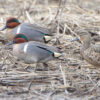
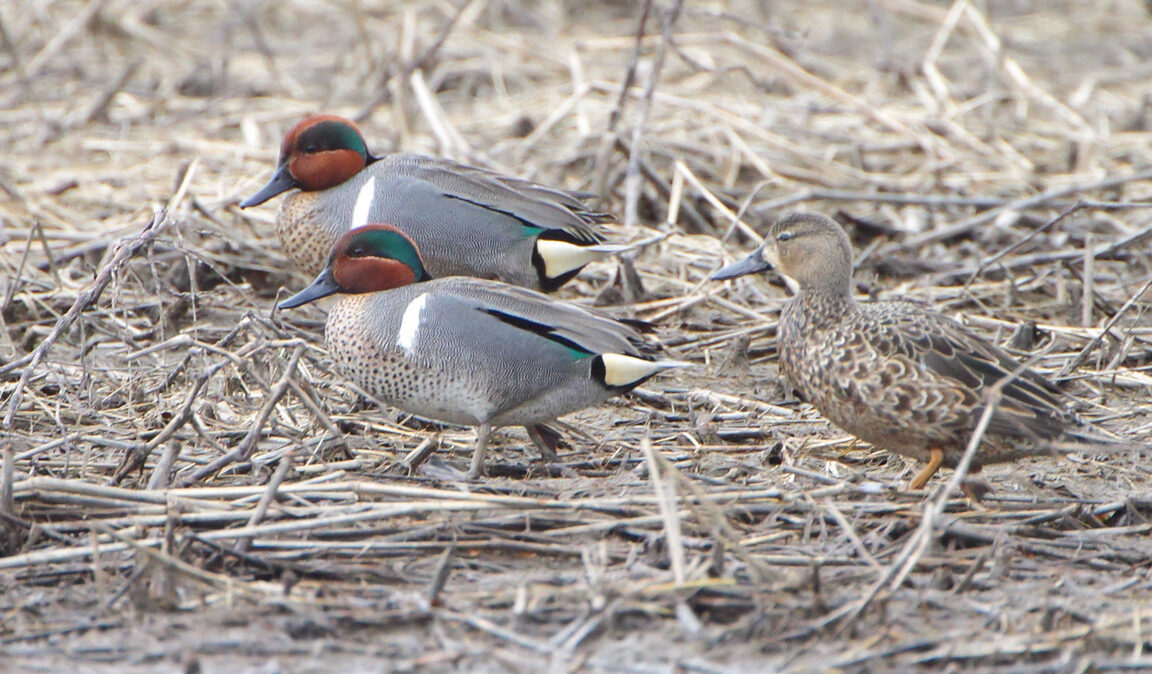
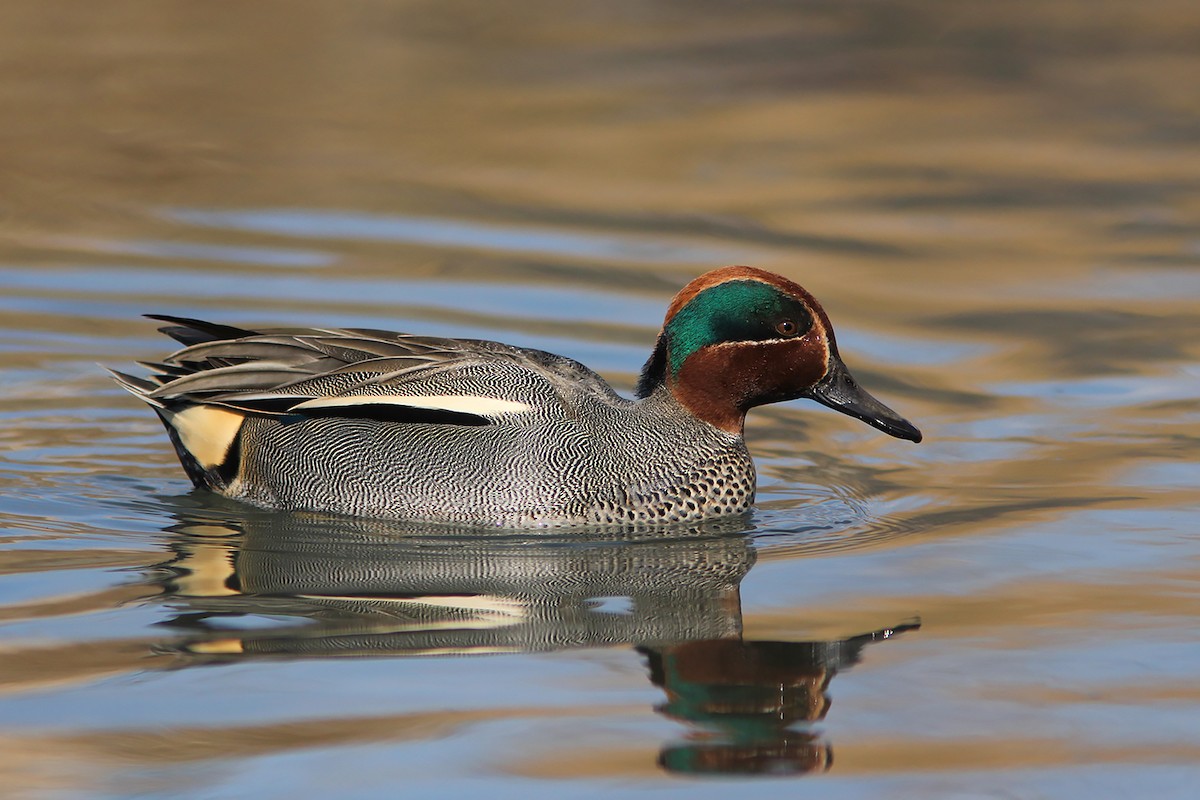
IDENTIFICATION: The male is really unlike anything else, but at a distance or in poor light, when his head just looks dark, his gray sides with a vertical white mark at the shoulder will usually do the trick (see banner photo above). His mate, plain though she is, will usually show a small whitish patch or streak along her tail in a side view; this doesn’t appear in female Blue-winged Teal (see below, left). In addition, her head is darker and less strongly patterned than a female Blue-wing’s, without the pale patch that species shows between the eye and the bill. In flight, both sexes are generally dark above with whitish lines bordering their partly green speculum (the rear inner wing), a pattern somewhat like a tiny Mallard—whereas Blue-wings in flight display their large powder-blue shoulder patches. The male Eurasian Green-winged Teal, not yet seen in Missouri, has a horizontal white streak along the upper wing instead of the vertical white shoulder mark. Females are identical.
ST. LOUIS STATUS: Very common as a migrant, typically March-April and again late August to November, found mostly in grassy, marshy areas with shallow water but sometimes in open water on larger lakes. In winter, variable but often around in small numbers and occasionally into the hundreds.
Learn more and listen to the calls of Green-winged Teals here.
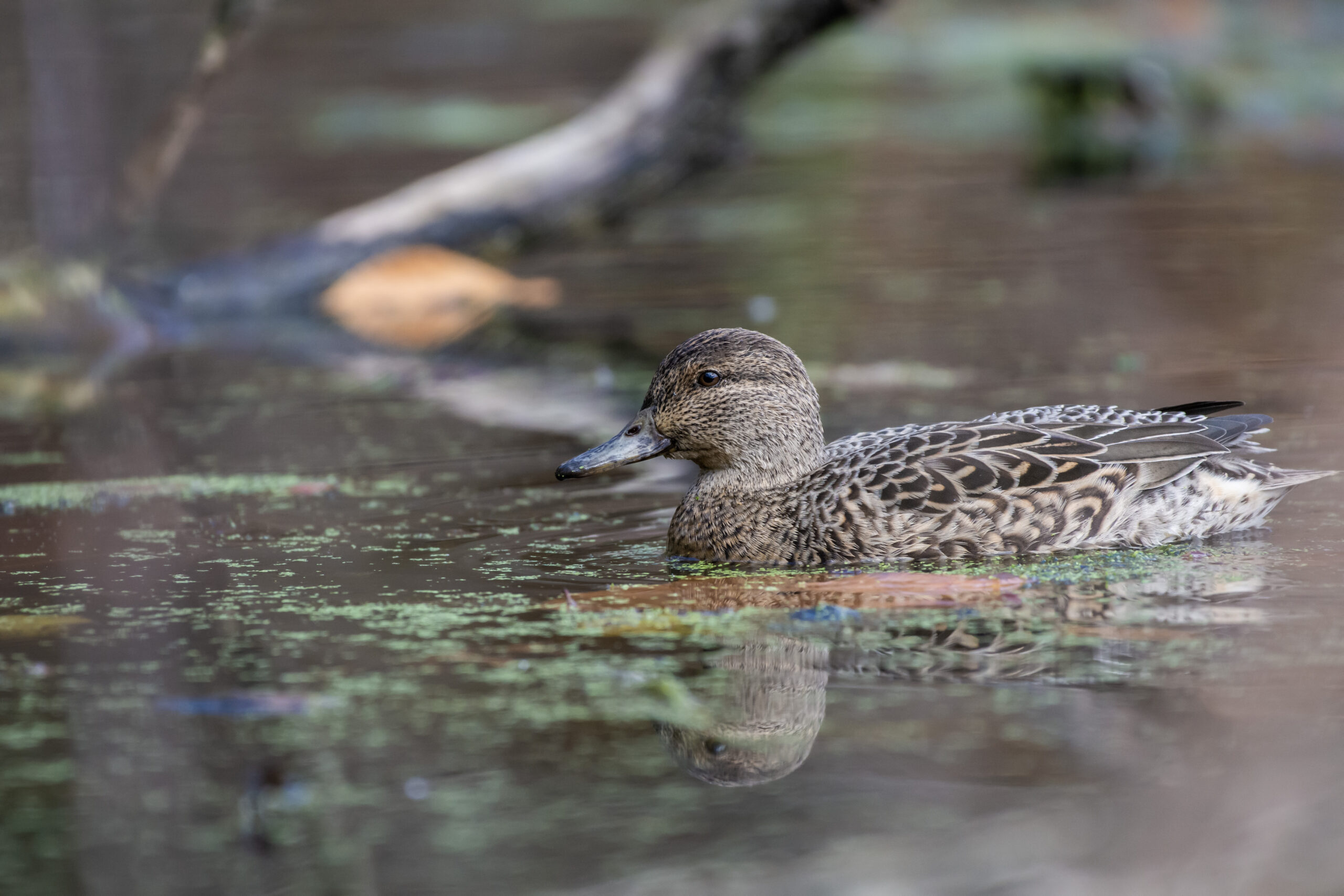
Female: note whitish streak below wings and beside tail, unlike female Blue-wing
Green-winged Teal. Photo: Eric Schertler
Male Eurasian Green-wing: note horizontal white streak along wing, no vertical one on side of breast
Photo Credit: Ayuwat Jearwattanakanok
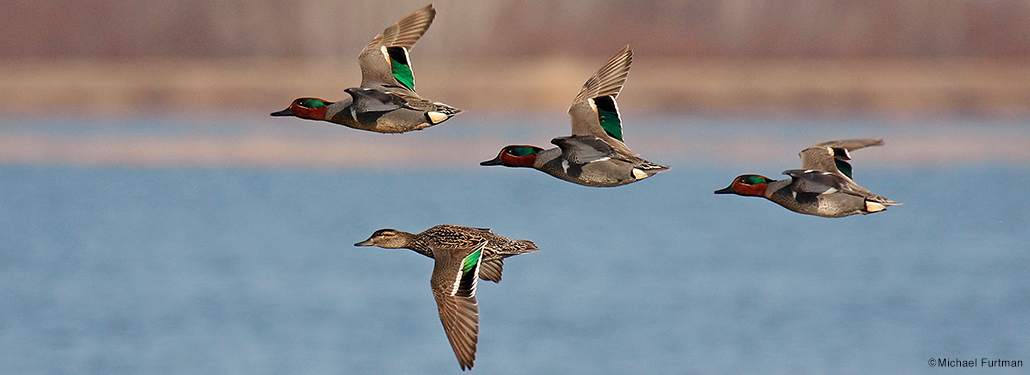
In flight, note wing pattern (see ID section)
Photo Credit: Michael Furtman
https://www.michaelfurtman.com/Photos/waterfowl/Gallery/Ducks, Dabblers/Green-winged Teal/GWT Flying/index.html