
Photo Credit: Al Smith
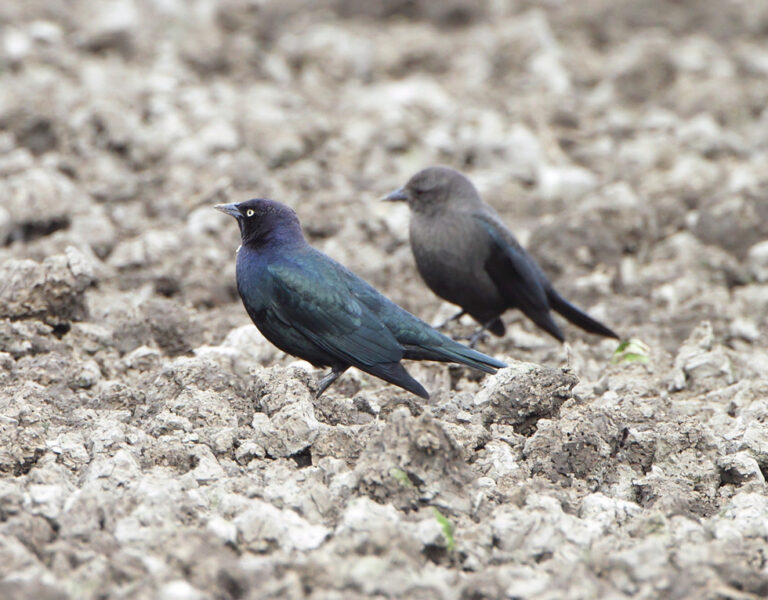
Brewer’s Blackbird, Euphagus cyanocephalus
Bill Rowe
Fall brings us hordes of blackbirds, forming long ribbons in the air and busy flocks that “roll” over the fields in their search for grain and insects. Identification is a problem: a flock that looked like one big mass at a distance can be hard to separate into species. It takes time and some closer views to pick out the redwings, grackles, and cowbirds, both male and female—and, come November, the less-common Euphagus blackbirds, the Rusty and Brewer’s, which we hope to spot as we approach a flock. These close relatives come to us from different directions, Rusties from the conifer forests of Canada, and Brewer’s from the open country to the north and west of us. An abundant bird in much of the American West, Brewer’s Blackbird can be seen there in almost any non-forested areas including ranchland, beaches, golf courses, even fast-food parking lots. During the twentieth century, it extended its breeding range eastward along a northern corridor in Minnesota, Wisconsin, Michigan, and Ontario, probably as a result of the clearing of forests for agriculture. Here in Missouri and Illinois it is a late-arriving migrant, found anywhere in the countryside but typically in crop fields and feedlots, often assembling on nearby trees or power lines, either among other blackbirds or in single-species flocks from a few to a hundred or more. It is rarer in midwinter but picks up again in early spring, from late February to mid-April. Birders enjoy finding it for their personal lists and for Christmas Bird Count records, an incentive that can turn other species into Brewer’s Blackbirds! To avoid this outcome, see the next section.
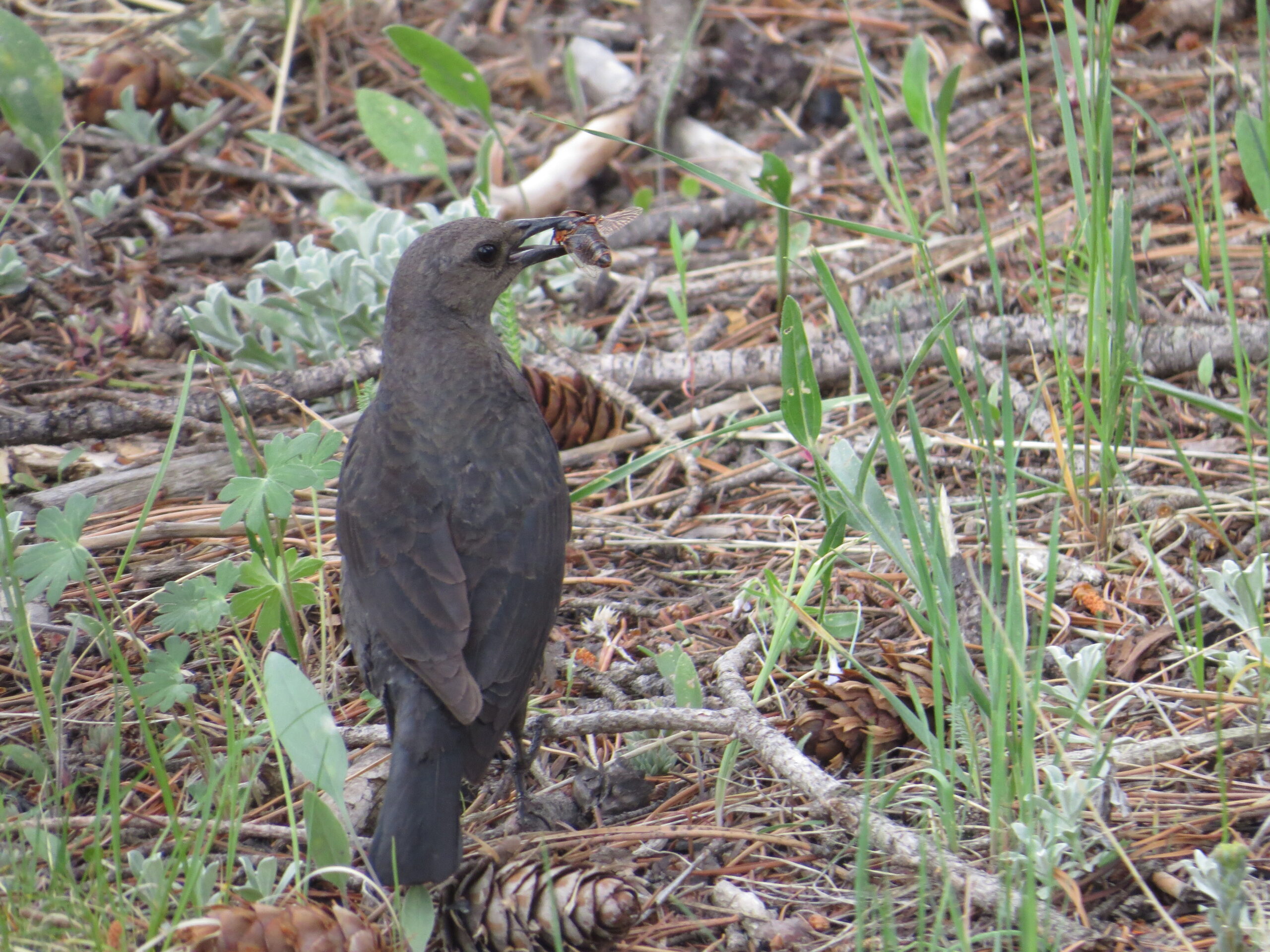
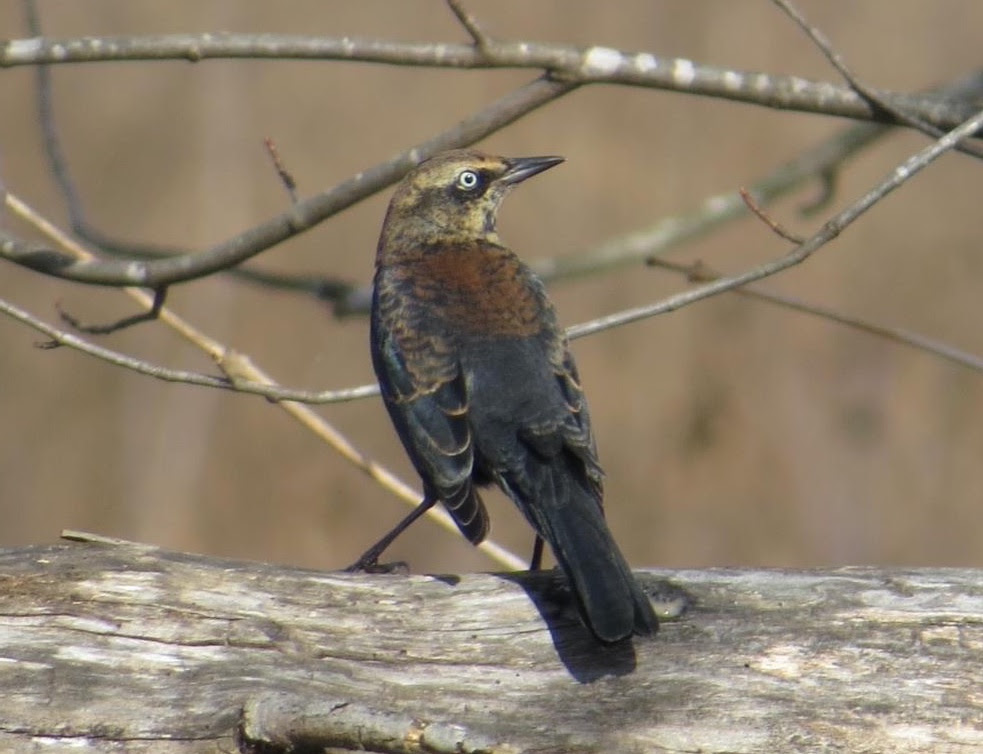
IDENTIFICATION: Brewer’s is a mid-sized blackbird, about the body size of a redwing with a longer tail (but not as long as a grackle’s). Its bill is medium-size, unlike the triangular bill of the smaller Brown-headed Cowbird or the longer, heftier bill of the larger Common Grackle. Its color patterns are consistent: (1) Males have a blue-green sheen on the body and a dark head that shows a purple sheen in good light; their eyes are a staring pale yellow like a grackle’s, but the colors just described are very different from a grackle’s bronzy body and shiny blue head. (2) Females are a dull gray-brown, often with a tinge of blue-green on the wings and tail; they nearly always have dark eyes, making this the only blackbird with different eye colors for males and females. The Rusty Blackbird, very similar in size and shape, is far more variable in color; in fall, however, it usually has enough rusty color and contrasting pattern on the head and breast to identify it, and its eyes are always pale. Male Rusties become all-black by spring, and a few are like that even in fall and early winter; this is a potential pitfall, but male Rusties don’t have the color contrast just described for male Brewer’s.
ST. LOUIS STATUS: A widespread migrant, mostly uncommon but occasionally in sizeable flocks, mid-October to early December; rare in midwinter. Normally found in farmland, wetlands with mudflats, and other open areas; unlike Rusties, not to be expected in woods, in most urban or suburban parks, or in residential areas.
Learn more and listen to the calls and songs of Brewer’s Blackbirds here.
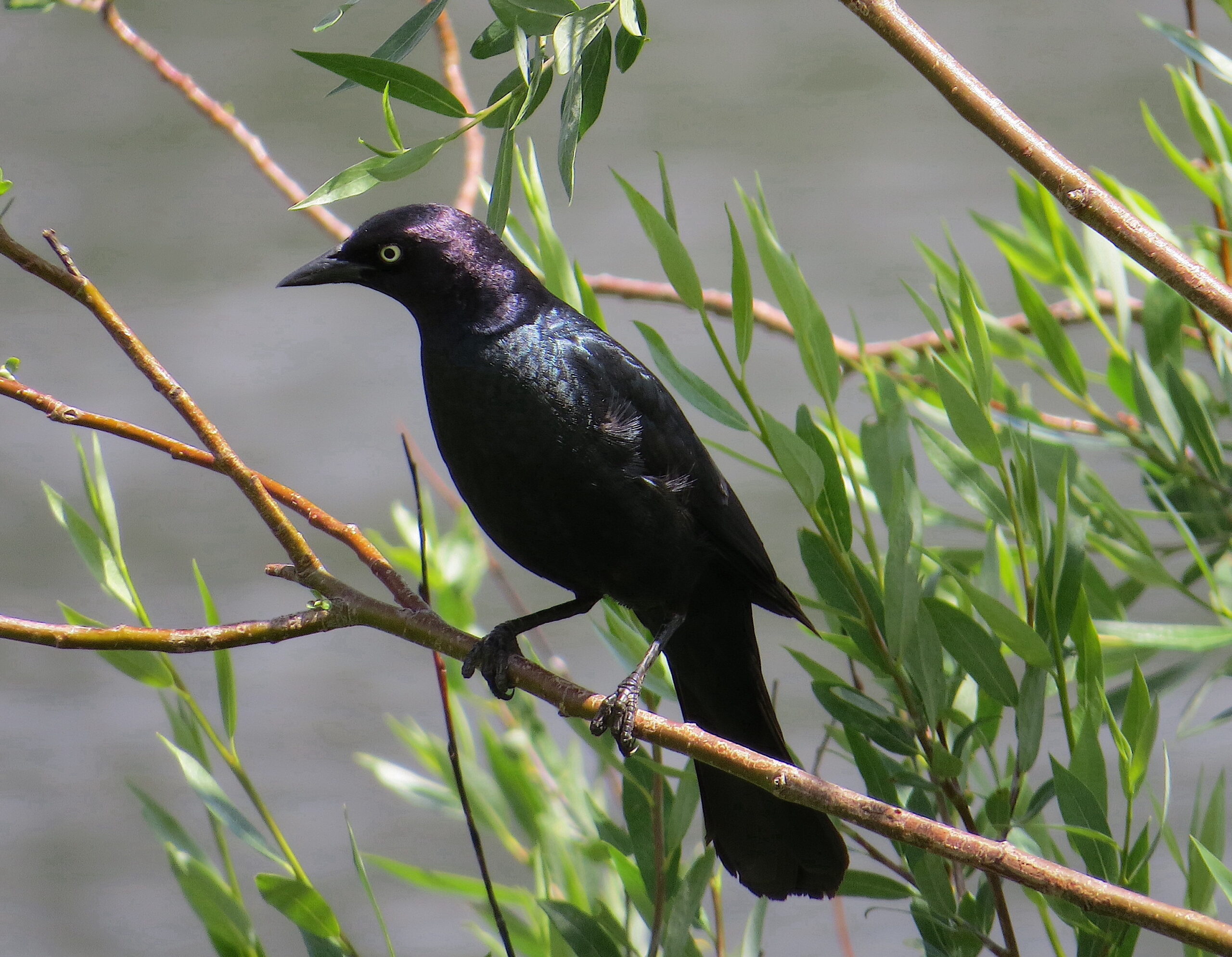
Male in sunlight: note color contrast of head vs. body
Photo Credit: Bill Rowe
Female with prey: note dark eye
Photo Credit: Bill Rowe
Fall Rusty Blackbird; note pale eye, strong face pattern, buff and rust colors.
Photo Credit: Bill Rowe