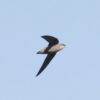


Chimney Swift, Chaetura pelagica
Bill Rowe
You hear high-pitched, chittering calls overhead; you look up, and there is a small brown bird darting across the sky, its body, head, and tail all seemingly rolled into one tube-like shape with narrow, pointed wings attached. The wings flicker so fast your eye can’t follow the movement as the bird zigzags, in pursuit of airborne insects. You are watching a swift, one of a family of about a hundred species worldwide, all of them spending most of their time in the air, and some of them so similar that you would be hard pressed to tell them apart—except for the fact that you are in eastern North America, where only one swift is normally found. That is the Chimney Swift, seen just about everywhere in the eastern U.S. and southern Canada, but especially in cities and towns. It actually does nest in chimneys; in fact, those are its primary nesting sites, along with some use of barns, outhouses, old wells, etc. That raises the question of where it nested before European settlement, and the answer is apparently cliffs, hollow trees, caves, and other natural cavities, which it may still use, at least on rare occasions. Its closest American cousin, the Vaux’s Swift of the Pacific northwest, hasn’t made the transition to the same extent and still uses hollow trees more than chimneys. The nest is made of twigs and is held together, and onto the chimney wall, by the birds’ saliva, which acts like glue. (In east Asia, the nests of certain swifts are the basis for bird’s-nest soup.) In fall, Chimney Swifts are on the move, often gathering in large flocks before heading south across the Gulf of Mexico and down through Mexico and Central America, to winter mostly in the Amazon basin of Peru, Chile, and Brazil. These flocks, some numbering in the hundreds or even thousands, will locate chimneys and other such sites as roosting spots during their travels and will funnel into them at sundown. Come December, they are all gone; there are no winter records of Chimney Swifts north of the Gulf coast and Florida, and even those are mostly uncertain, as they do not eliminate the very similar Vaux’s Swift, which has been carefully identified in winter there, notably in Louisiana.
IDENTIFICATION: Most of the time, a Chimney Swift is easy to identify by its cigar-shaped body, seemingly tailless, and its twinkling flight on long, pointed wings. More distant birds may be a bit tricky to separate from swallows, which are also small, active fliers; but swallows have a distinct tail, often notched, usually some white or other pale color below, and their flight is a bit more direct and “followable.” Any swift seen in winter, or even as late as November, should be observed carefully and photographed if possible, since Vaux’s Swift is probably more likely then. That species, a little smaller, is paler on throat and breast than Chimney and paler brown on its rump than on its back; its chip notes are faster and higher-pitched than Chimney’s. Very careful documentation is needed to separate them.
ST. LOUIS STATUS: A common, widespread summer resident, arriving in April, or exceptionally at the end of March. Fall migrants are seen in August, September, and October, sometimes in large flocks.
Learn more and listen to the calls of Chimney Swift here.
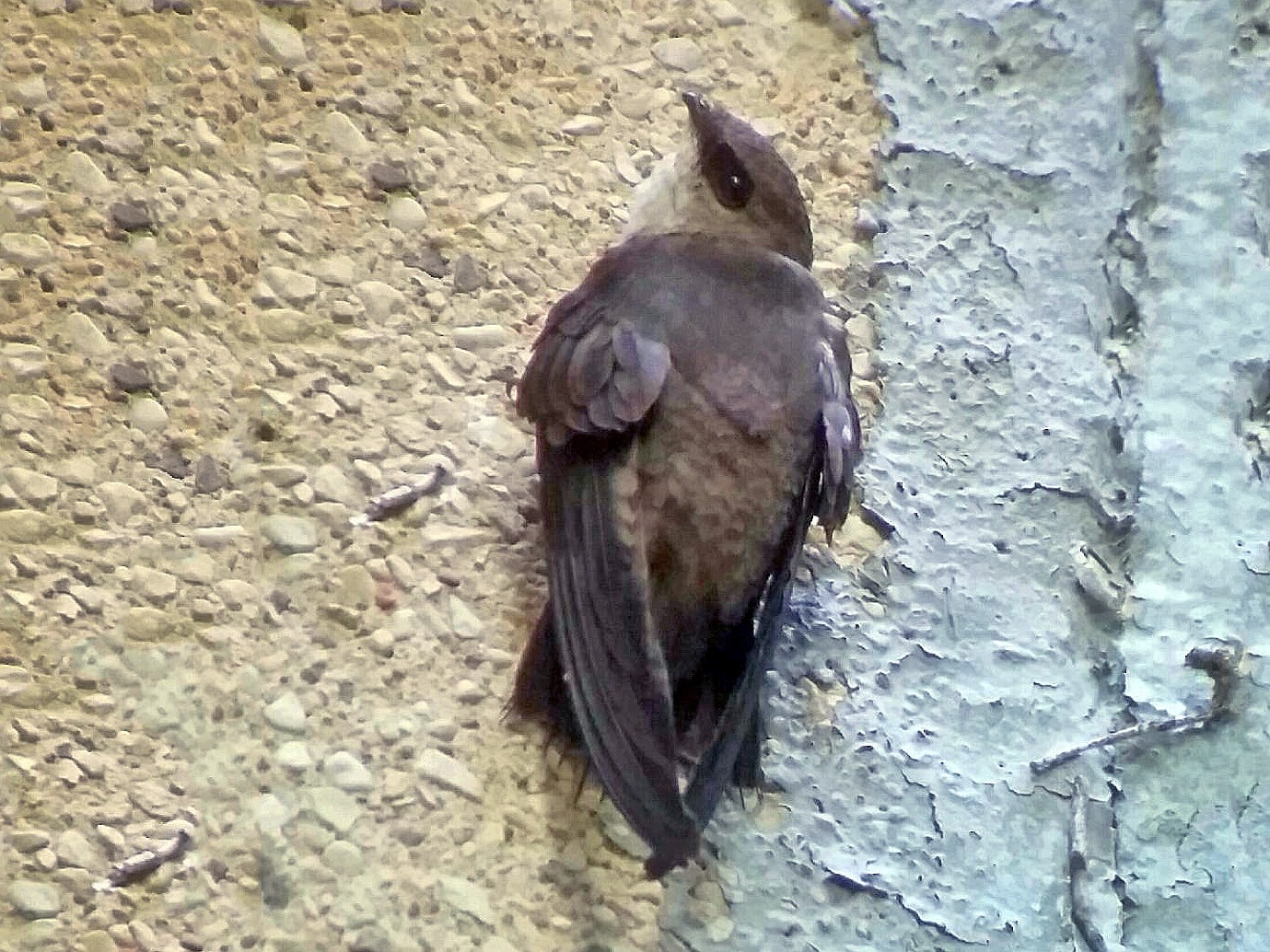
Tiny feet hold the swift onto the wall
Photo: David Scrab, Birds of the World
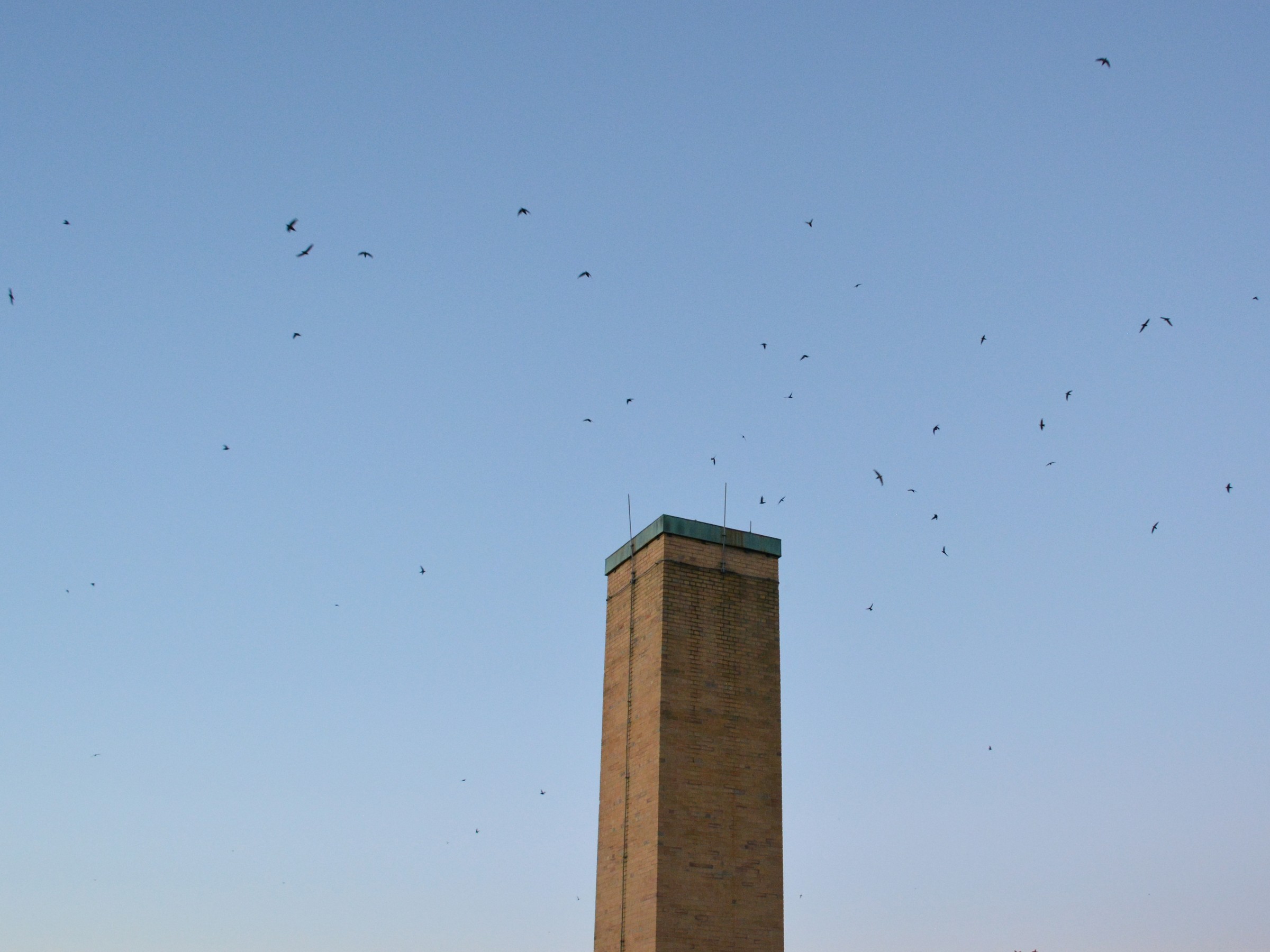
Migrant swifts entering a roost site
Photo: Ryan Treves, Birds of the World