
Yellow-breasted Chat, Icteria virens
Bill Rowe
Most birders will agree that the Yellow-breasted Chat is a cool bird—it’s handsome, interesting, and …different. Through many decades and many iterations of field guides, it was classified among the warblers in the family Parulidae, even though it was obviously unlike the rest of them, being larger and thicker-billed, with songs and behaviors that would have left the other warblers wondering where this weird cousin came from. Now, thanks to the incredible recent advances in genetic studies that can, at least partially, disentangle the lineage of any organism and discover its true relationships, the chat has been found to be not a warbler (though with some affinities), nor a blackbird (again, with some affinities), nor a bunting, nor a tanager, nor anything else (including no relationship to the Old World birds called “chats”). It has always been the sole member of its genus Icteria, but as of 2017, because of its “genetic distance” from all those well-defined families, the chat has been placed in a family all its own; it is the sole member of the newly-established Icteriidae (easily confused with the blackbird family Icteridae; note the extra “i”). This could change, of course, but meanwhile we can enjoy its uniqueness as we listen to a chat delivering its bizarre song from a shrubby field or forest edge, where it lives along with other common summer birds like Indigo Buntings, Eastern Towhees, and Field Sparrows. Most of the time a chat will be skulking in the shadows, but if you’re lucky it may sing from a visible perch on a tree branch or bush top, allowing you a good look at its brilliant yellow underparts. The song is a disjointed series of whistles, clucks, and chatters, separated by short pauses; each piece sounds as if it comes from a different bird. To compound the uniqueness, chats will sing at any hour of the day or night, and they may accompany the song with a display flight, bounding downward with jerky wingbeats from a high perch to a lower one. Their nesting range covers a lot of the United States, east and west, except for the northeastern and north-central states and the higher western mountains, and it extends into southernmost Canada and northern Mexico. They spend the winter in southern Mexico and Central America, with some in south Florida and a few others toughing it out along the Atlantic coast.
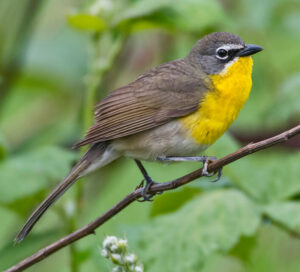
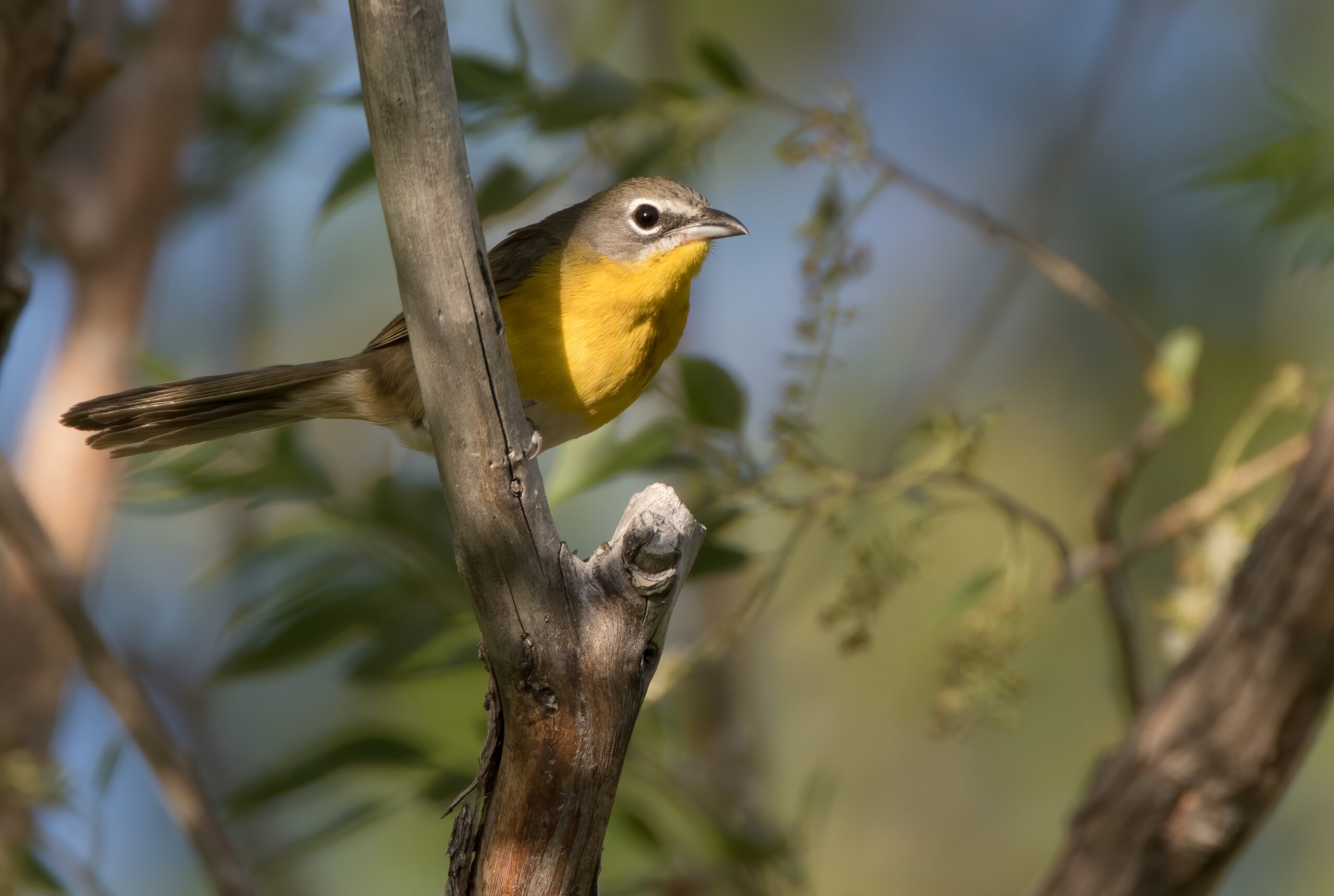
IDENTIFICATION: There is nothing like a Yellow-breasted Chat, with its golden breast, thick bill, and white facial markings. Males and females, and even juveniles, look much the same. Typically, you will locate chats by hearing them sing and tracking them down; since they mostly stop singing by late summer, they can become very hard to find.
ST LOUIS STATUS: One of the common birds of “old fields” and woodland edges (i.e., open areas that are uncultivated and partially overgrown with tangled shrubbery and small trees). Found throughout the countryside; on public lands, look especially in conservation areas, state parks, and wildlife refuges. Most chats are seen late April to late August; by early October they are rare, and we have just one early-December record in the St. Louis area.
Learn more and listen to the songs and calls of Yellow-breasted Chats here.
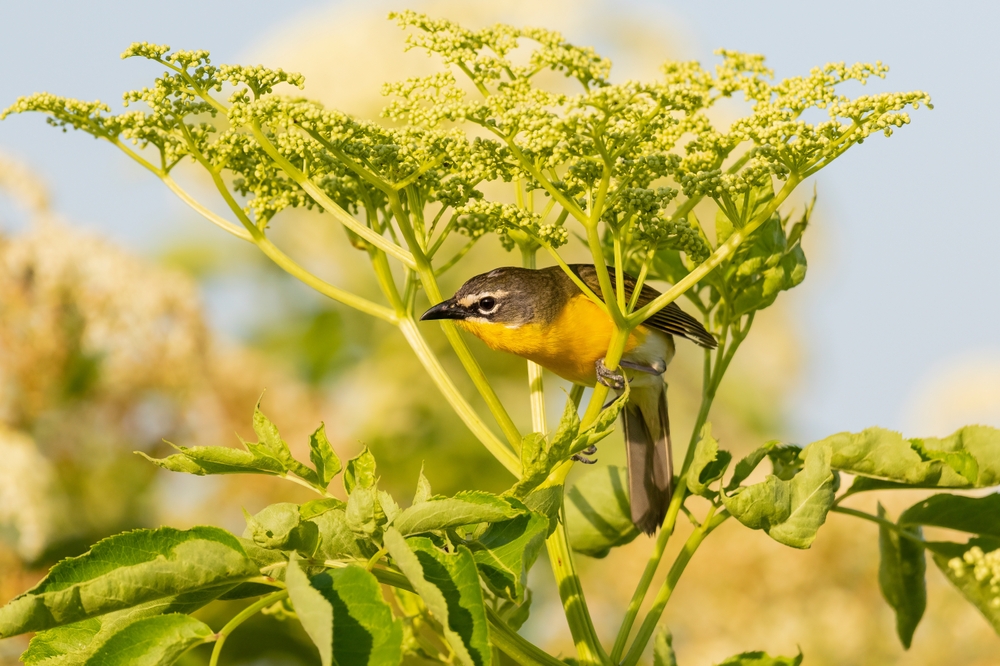
Male in another typical pose
Female: similar except lores and bill gray instead of black