
Bonaparte’s Gull, Chroicocephalus philadelphia
Bill Rowe
Bonaparte’s Gull, the smallest of our four common gull species, breeds far to our north, in the Canadian and Alaskan taiga (a Russian word meaning the boreal forest of pine, fir, and spruce). There, unlike other gulls that nest in colonies at ground level, it builds its nest in the branches of conifers near water, on islands or around the edges of lakes and marshes. It spends the winter along all our coasts and on the lakes and reservoirs of the southern states, extending into northern Mexico and the Caribbean, and in between it is a common migrant throughout the U.S. Words like “pretty” and “charming” may not often occur in the same sentence with “gull,” but they do apply rather well to this species, with its handsome colors and its elegant tern-like flight. Like other gulls, male and female Bonaparte’s are identical in plumage, but young and old are not; see below for age differences. In addition, it is one of several smaller species in which the adults have a distinctive dark hood in breeding plumage, making it easy to tell whether a bird has completed its pre-breeding molt, has not yet started it, or is part way through the process. Individuals seen in April can be at any stage of their hood development, from 0 to 100%. This species is not named for Napoleon, but rather for a nephew of his, Charles Lucien Bonaparte, an aristocrat who became a serious naturalist. He came to the United States in 1822 (age 19), lived here until 1826, studied our birds, and helped to revise and expand Alexander Wilson’s book on the birds of America. Back home, even as he became heavily involved in European politics, he remained an influential scientist, describing and naming over 200 species of birds from around the world.
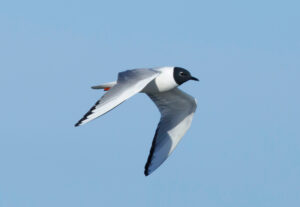
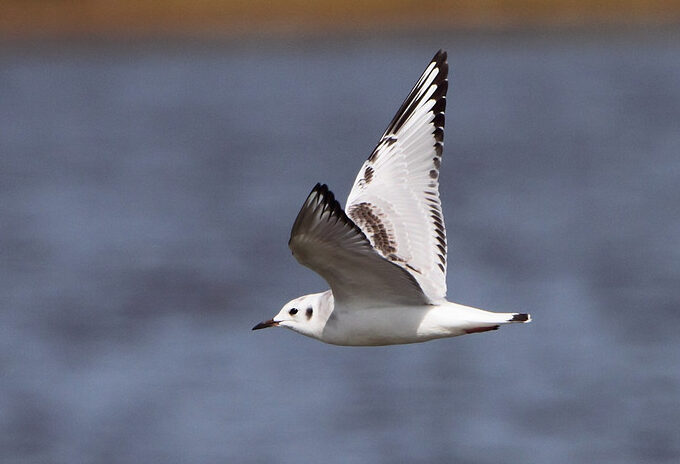
IDENTIFICATION: The adult is a small gull, just slightly larger than a Forster’s Tern, with a slender black bill and a long white “slash” or narrow triangle along the outer wing, obvious in flight. In breeding plumage, it has a dark hood (see above); in nonbreeding plumage, just a dark spot behind the eye (see below, left). Young birds in their first fall and winter show a dark bar across the “shoulder” (called a carpal bar), some blackish in their primaries, and a narrow black tail band (see below, right). By their second year, they are adults. Check your field guide for two possible rarities that could accompany them: Little Gull and Black-headed Gull. The latter species closely resembles Bonaparte’s but is a little larger with a dark reddish bill and black under the primaries, where Bonaparte’s is white.
ST. LOUIS STATUS: Common in March-April and again October-November on all larger bodies of water, occasionally in the hundreds (as sometimes at Riverlands) or even in the thousands (as on Carlyle Lake every fall). Sometimes present in winter, but not usually in numbers except at Carlyle.
Learn more and listen to the calls of Bonaparte’s Gulls here.
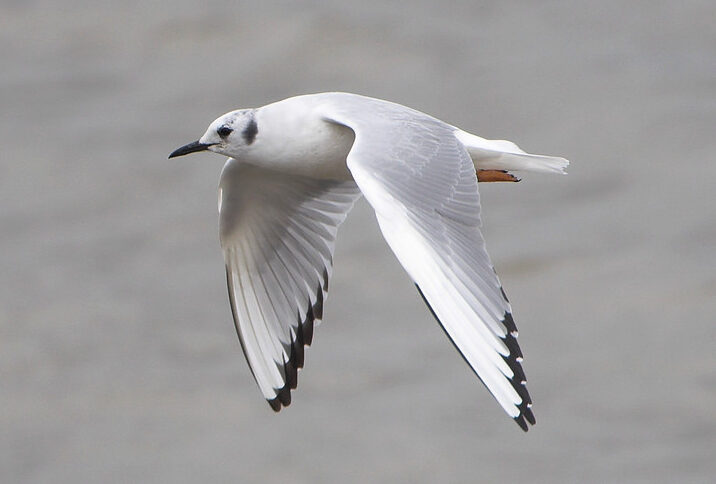
Nonbreeding adult;
note head and wing pattern
Photo Credit: Al Smith
First-winter bird: note wing and tail patterns as described above
Photo Credit: Al Smith
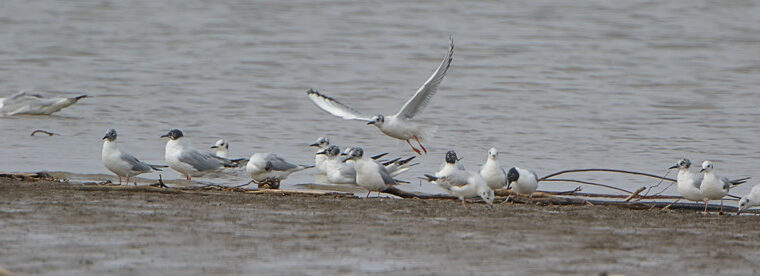
April flock, with birds in various stages of molt
Photo Credit: Al Smith