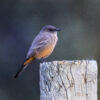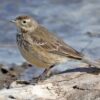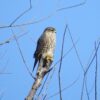

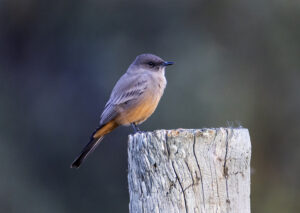
Say’s Phoebe. Photo: Steve Greenwood
Say’s Phoebe, Sayornis saya
Bill Rowe
The New World flycatchers, or “tyrannids” (family Tyrannidae), form an important group of our birds, with many different subgroups that may proliferate in the tropics but have at least one representative here in the Midwest, like the pewees, the kingbirds, and the empids (genus Empidonax). One good, prototypical flycatcher to learn about on the local scene is the Eastern Phoebe, a common breeding bird in rural areas and generally easy to identify. For those who want to learn all the birds of North America, phoebes are again helpful in that there are only two more of them in the whole genus (Sayornis), both western U.S. birds and even easier to identify. Of these two, Say’s Phoebe has become a somewhat regular visitor to our region from farther west. Out there, it is a common summer bird in open, sometimes arid, country like farmland, ranchland, and sagebrush steppe, spreading eastward into the central plains of Kansas, Nebraska, and the Dakotas. Here in Missouri, as an occasional migrant and winter visitor, it would still be considered a real rarity at the local level, but statewide there are now about fifty records—in other words, it’s a bird you would never really expect to see but one that might just pop up and surprise you almost anywhere and in any month of the fall, winter, or spring. As on its breeding grounds, a vagrant Say’s Phoebe is generally found in open areas, perching on shrubs or fences, or fluttering around after insects in a field of short grass or plowed dirt. This species, by the way, was named in honor of the early American naturalist Thomas Say, who first discovered it on a trip west, in Colorado; he gained worldwide fame in the 1820’s and 30’s for his work on insects, crustaceans, and reptiles. And the third phoebe species, the Black Phoebe of the southwest and the Pacific coast, is all blackish with a white belly and mostly lives near lakes, rivers, and other wetlands. Never yet found in Missouri, it has shown up as close as northeastern Oklahoma.
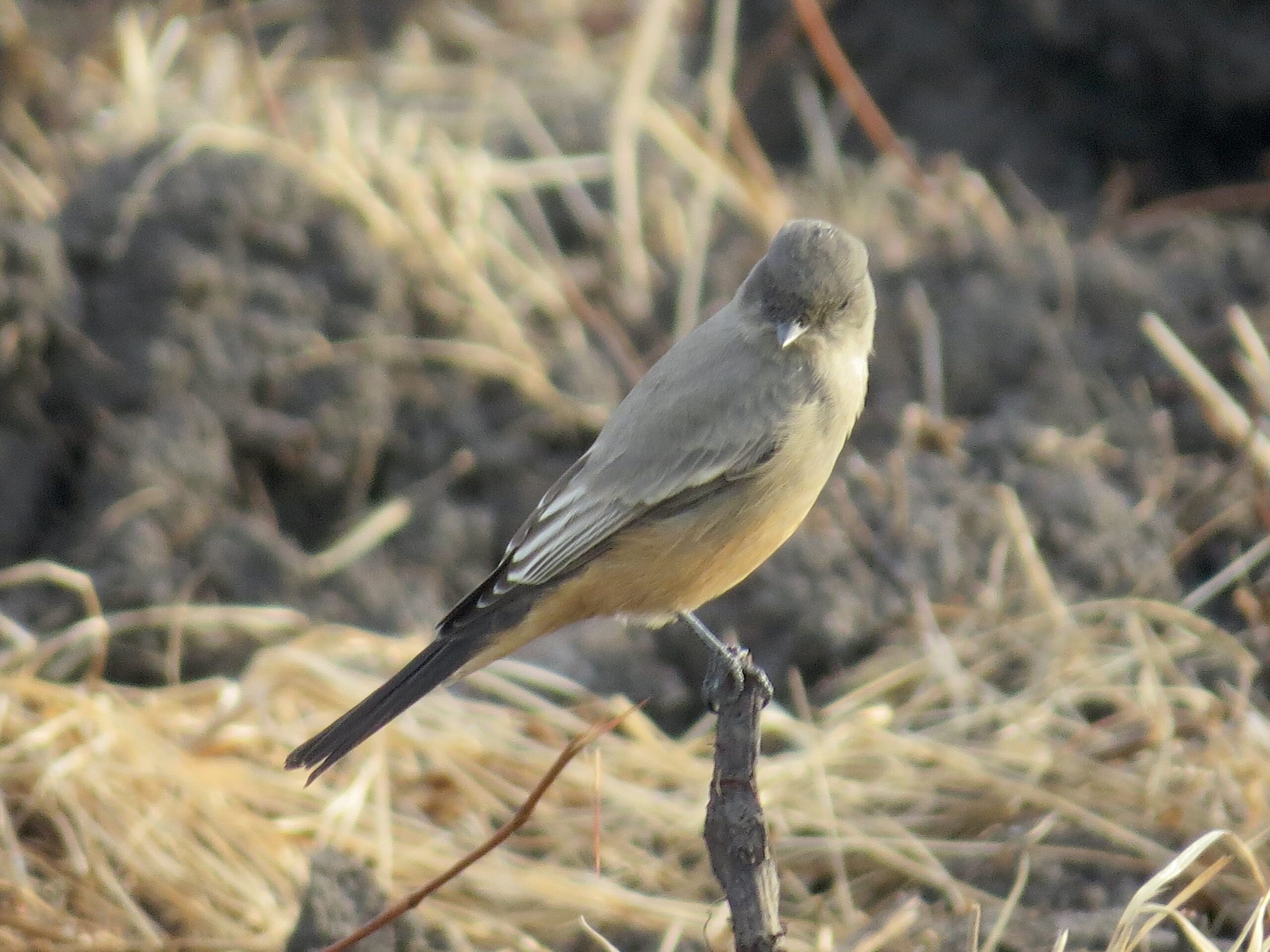
IDENTIFICATION: Pretty much unmistakable with a good view. This is a fairly small flycatcher, about seven inches long; it has a medium gray back and a darker gray head blending into a pale gray throat and breast, which in turn blend into an orange-rusty belly and undertail. The tail is long, mobile, and all black. This color scheme is unlike that of any other flycatcher, and all plumages are much the same, although juveniles in late summer would appear browner, with cinnamon wingbars instead of whitish ones.
ST. LOUIS STATUS: As noted above, this bird is rarer locally than it is statewide, partly because we are on the east side of the state and thus farthest from the species’ normal range. Nonetheless, there are about eight records for the St. Louis area, broadly defined (including the Illinois side), and three of these were within the past six months (April, May, and September 2026).
Learn more and listen to the songs and calls of Say’s Phoebes here.
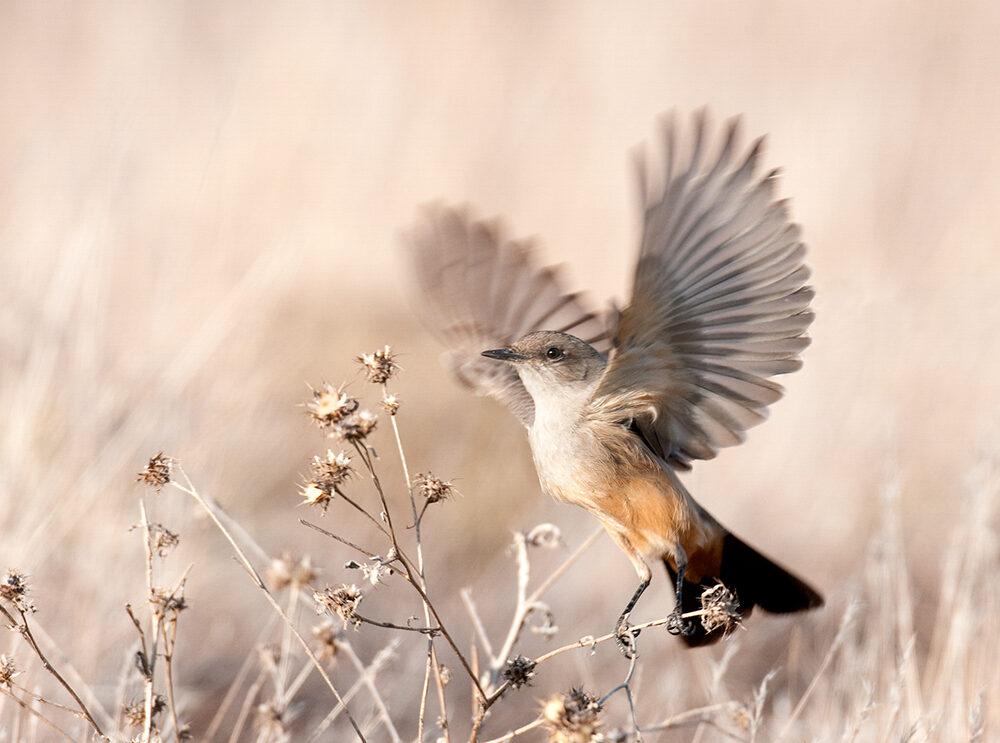
Note all-black tail, prominent in flight
Say’s Phoebe. Photo: Stan Keiser
A nearby Say’s Phoebe: Pike Co., MO, September 2026
Photo: Bill Rowe