
Baird’s Sandpiper, Calidris bairdii
Bill Rowe
Above, you see another of the Olympic-level migrants among our shorebirds—not as famous as, say, the American Golden-Plover, but every bit as astonishing in the scope of its annual journey from the Arctic tundra to South America, a trip of up to 9,000+ miles accomplished in just 5-6 weeks, and then back again in spring. The breeding range of Baird’s Sandpiper stretches from northeastern Canada, even a bit of Greenland, west across the Canadian Arctic, much of Alaska, and even a bit of Siberia. Starting in July, once the young have fledged, adults take off southward down the center of the continent until they reach the coasts of Colombia and Venezuela; then they make their way down to the areas where they will winter, as far as Tierra del Fuego for some. (Those were the adults; the juveniles follow behind them on a broader front, with more seen on the coasts as well as throughout the interior.) En route, while Baird’s may outnumber other sandpipers at certain stopovers—for example, near the Rocky Mountains—it is more often an uncommon bird, found in small numbers. This, plus the general difficulty of identifying sandpipers, may be why it is very much a “birder’s bird,” not well known or much publicized. We hope this article will help! With a bit of study and experience, Baird’s Sandpiper is also rather attractive and distinctive, especially in its juvenile plumage. Note: Spencer Baird, a protégé of John James Audubon, became one of the top naturalists of the nineteenth century and eventually the second Secretary of the Smithsonian Institution; this species was named for him by one of his own protégés, Elliot Coues, a leading ornithologist of the next generation.
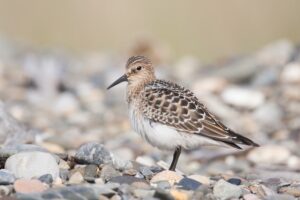
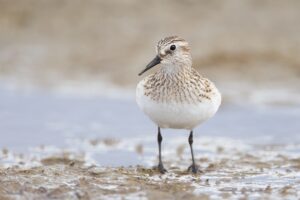
IDENTIFICATION: The best starting points for identifying sandpipers are SIZE (in comparison to any nearby birds) and STRUCTURE. Baird’s can be grouped with the White-rumped Sandpiper in both respects: (1) Its size is medium-small, in between “peeps” (like Least Sandpiper) and “middle-sized” (like Pectoral Sandpiper), i.e., about the size of a bluebird or a waxwing. (2) It has long primaries, or wing-points, that stick out well beyond the tip of the tail, giving it a long-tapered look; this is usually easy to see and will separate it from everything except the White-rump. In addition, check BILL and LEGS: (3) Baird’s has a straight black bill and black legs, separating it from yellow-legged species like the Pectoral. Now for PLUMAGE: (4) A majority of the Baird’s that we see are fall juveniles, which are tan or buffy-brown on the head and breast, with fine streaking, and scalloped with dark centers and white fringes on all the small feathers of the back and wings (see photo above). (5) Spring adults (breeding plumage) have larger back and wing feathers that produce a patchwork of black and silver spots, while the head and breast are still brownish and streaky. Non-breeding plumage (late fall, winter, early spring) is duller, so size and structure are even more important.
ST. LOUIS STATUS: Uncommon but regular in fall, mostly juveniles and mostly August through October, with some lingering into November; spring-migrant adults come through late March to May and may be harder to pick out.
Learn more and listen to the calls of Baird’s Sandpiper here.
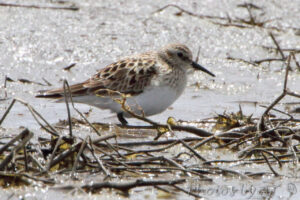
Breeding-plumage adult; see ID notes
Photo Credit: Al Smith
Note Baird’s “flattened oval” shape when facing us
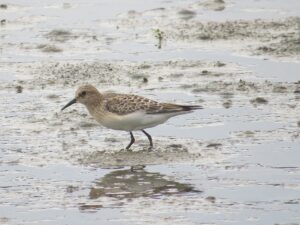
Another fall juvenile; note long wings, scalloped back
Photo Credit: Bill Rowe