
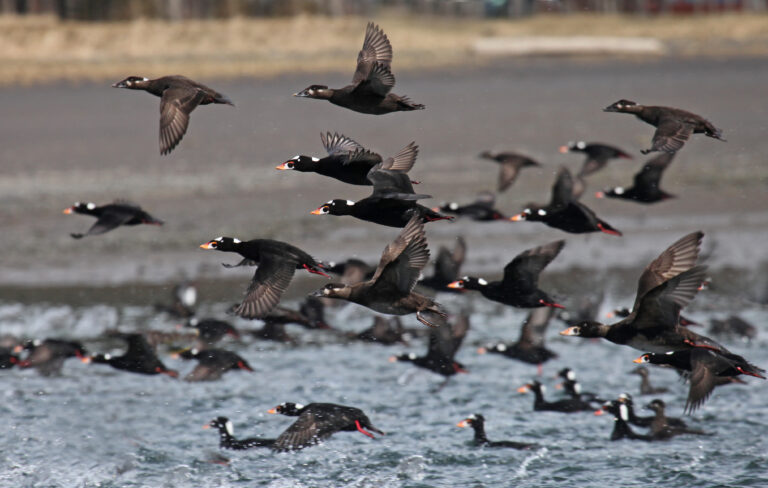
Surf Scoter flock. Photo: Tim Bowman
Surf Scoter, Melanitta perspicillata
Bill Rowe
First, a disclaimer: in Missouri, you’ll never see a big flock of Surf Scoters like the one in the photo above, which might be on the Atlantic or Pacific coast. Here in mid-continent, all scoters are scarce migrants and winter visitors, in small numbers. Of our three North American species, however, the Surf Scoter is the one we see most frequently here—and late fall is the best time of the year. In general, scoters are medium to large ducks that nest far to our north in Alaska and Canada; come fall, they become sea ducks, migrating south primarily along both coasts and then spending the winter mostly on open salt water near shore. Those that migrate through the interior will accompany other species such as Ruddy Ducks, Canvasbacks, goldeneye, etc., usually one or two at a time, occasionally in a small flock, feeding as they go by diving to the bottom for their typical diet of small animal life. This often includes clams and mussels, which they consume shells and all. Our field guides used to say that the Surf was the only exclusively North American scoter, since the other two, the White-winged and Black Scoters, bred in Europe and Asia as well. Recently, however, those two have been split so that their Old-World forms are now considered separate species: the Common Scoter (Eurasian “sister” to the Black), and the Velvet and Stejneger’s Scoters (Eurasian “sisters” to the White-winged). That still leaves the Surf Scoter as our only North American species that doesn’t have a closely similar relative in the Old World. And while it is a strictly American breeding bird, it does show up fairly often, by ones and twos, as a vagrant in Iceland, Ireland, the U.K., Scandinavia, and even France, Spain, and Portugal (data from eBird, past 5 years).
IDENTIFICATION: Scoters in general are dark, with sloping head profiles and big bills. Adult male Surfs are unmistakable; see the males in flight above, all black with white head patches and weird orange bills. Females and immature birds are not so striking but still well marked, with a dark cap and a paler brown cheek that contains two large white spots (again, check the flight shot above). The only problem is that female and young White-winged Scoters look similar; and so, if the bird is at rest and you can’t tell whether or not it has a white wing-patch, you have to rely on the head pattern. The photo below, left, shows how the front white patch, and the feathers it occupies, end abruptly at the bill in a vertical line. For a White-winged Scoter comparison, see below, right: the feathers and the pale patch on them continue out onto the sides of the bill. This all makes that front patch look slightly vertical in the Surf, horizontal in the White-winged. In addition, the whole face (behind the white spots) is uniformly dark on the White-winged, unlike the two-toned, capped appearance on the Surf. If this turns out to be hard to observe, give it a few minutes and wait for a wing flap!
ST. LOUIS STATUS: Rather rare here, but still not a big surprise between mid-October and mid-December (the main period of migration for most waterfowl); may also appear in March-April, more rarely in midwinter. The most likely places are larger lakes and rivers: Riverlands, Creve Coeur Lake, Carlyle and Horseshoe Lakes in Illinois, etc.
Learn more and listen to the calls of Surf Scoters here.
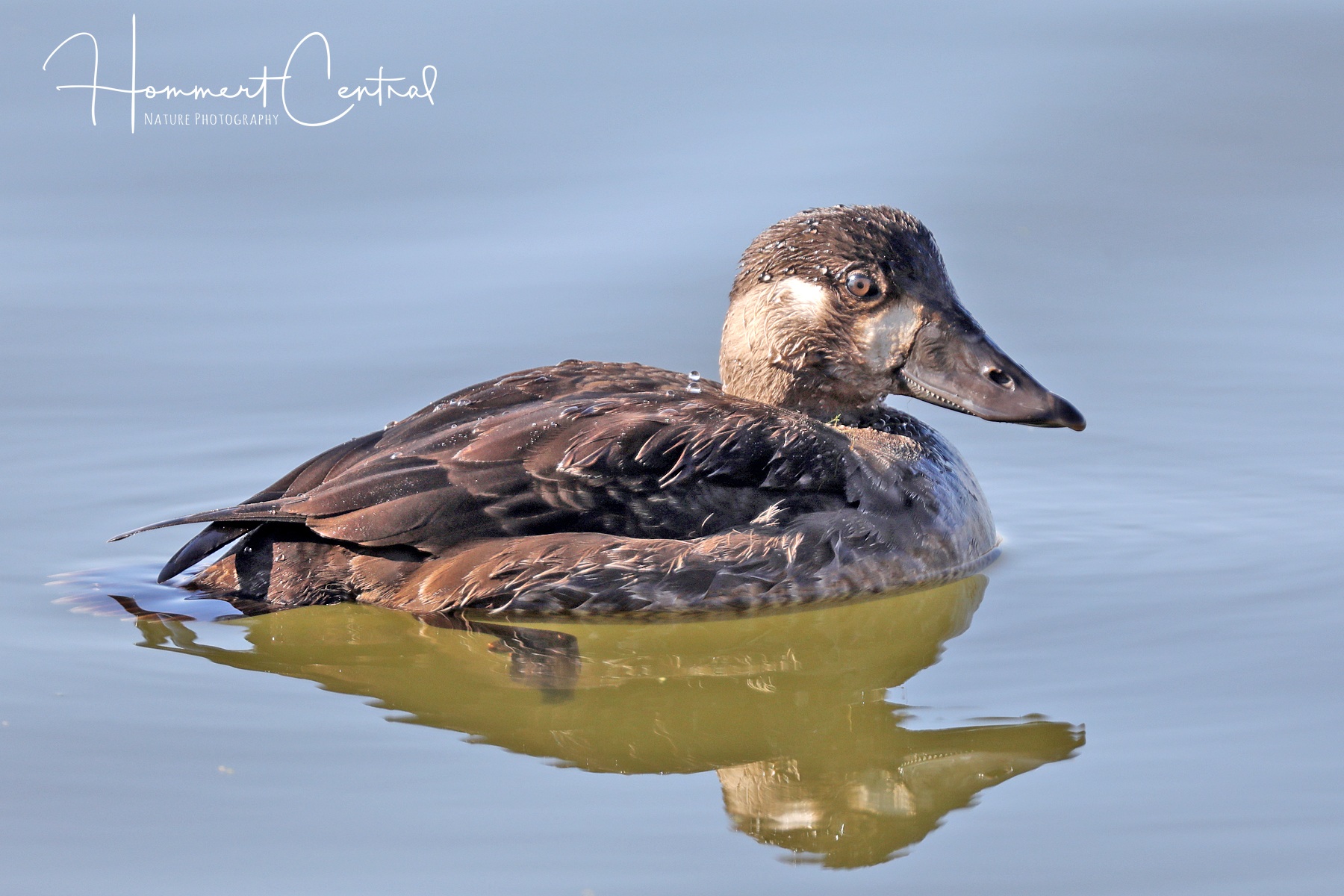

Female or imm. male Surf Scoter: note features as described in ID section
Photo: Doug Hommert
Female-type White-winged Scoter: again, see ID section
Photo: Doug Hommert