

Canvasback, Aythya valisineria
Bill Rowe
North America’s ducks come in a wide assortment of shapes, colors, and sizes; here in the Midwest, late fall, winter, and early spring are the prime times for enjoying the greatest variety of ducks before most of them head back north again. The Canvasback, named for the sail-like whiteness of its body, is a distinctive one both by color and by shape, and it typically shares the deeper water with other diving ducks like its close cousins the Redhead and the two scaup species, plus the Common Goldeneye, Bufflehead, and Ruddy Duck, and the mergansers. It became famous as a desirable bird for the table back in the nineteenth century, for instance around Chesapeake Bay, where its staple food was wild celery—in fact, its species name (valisineria) is simply the genus name of the wild celery plant, also called eelgrass. This diet has changed at least somewhat, but wintering Canvasbacks still subsist primarily on submerged plant life, followed by animal life like small clams and worms. Hunters still prize the bird. The rules for taking it (where, when, and how many) are carefully micromanaged and may change every year by region, depending on its nesting success in the prairie potholes of the northern Great Plains and its overall population, which may fluctuate rather widely on either side of half a million. This makes the Canvasback, by waterfowl standards, not all that numerous, even though locally it can seem abundant at certain times (see St. Louis status). Like a number of our other birds, the Canvasback is a strictly North American species but has a close counterpart in Eurasia: the Common Pochard, which looks much like it and fills much the same ecological niche.
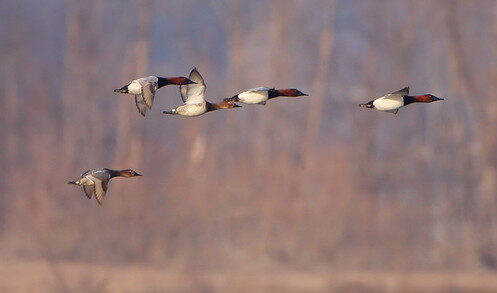
IDENTIFICATION: More than most ducks, Canvasbacks of both sexes can be identified simply by silhouette: their ski-slope profile, from the forehead down through the long, tapered bill, is unique. But the same is true of their color scheme: the male’s rusty red-brown head, black chest, and all-white body are pretty much unmistakable, while the female echoes this pattern with a more modest paler-brown head and silvery-gray body. With a reasonably good view, these same features will identify them in flight, with no need to worry about the wing pattern, which is plainer than those of most ducks.
ST. LOUIS STATUS: Found regularly, November through March, on lakes and rivers with reasonably deep water and a good source of underwater food; it is commonest by far, however, on and near the Mississippi River. Numbers are highly variable and often modest, but larger flocks (100’s) may occur during migration or winter cold spells, and the vagaries of our mid-continent weather can occasionally bring us Canvasbacks by the thousands.
Learn more and listen to the calls of Canvasbacks here.
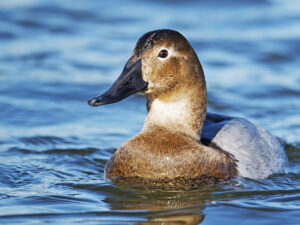
Female
Canvasbacks in flight
Photo Credit: Al Smith