
Photo Credit: Al Smith
Bank Swallow, Riparia riparia
Bill Rowe
Of our six common swallows here in eastern North America, five are small birds, more or less sparrow-size (the Purple Martin is larger); and when they are lined up side by side on power lines, it’s clear that the smallest is the little Bank Swallow, at just over five inches long. During the breeding period it is highly localized, since it nests colonially in sandbanks along rivers and streams or in sand and gravel quarries, digging dozens or hundreds of holes in which the young are raised—and suitable places of this type may be few and far between. Outside that period, however, in spring and fall migration, it may be seen all over the place, mixed with other swallows or on its own. To get ready for fall migration, swallows tend to start congregating early, and some of the flocks may be predominantly Bank Swallows. Like the Barn Swallow and unlike the other four, this species is cosmopolitan; you can see it in Chile, England, South Africa, Japan, and elsewhere on five continents at one time of the year or another (nesting in the Northern Hemisphere, wintering in the Southern). English-language sources in the Old World call it by its British name of Sand Martin, which, like our name, reflects its nesting habits. Its highly migratory nature results from its sole food source, the abundant insect life of fields and wetlands, mostly unseen by us, which the Bank and other swallows capture on the wing. Those insects, of course, disappear as the weather turns cold, and the swallows have evolved to migrate south, the Bank being one that makes a very long trek from North to South America and from Europe to sub-Saharan Africa. In the Eastern Hemisphere, it has several relatives in the genus Riparia, but on this side of the pond(s) it is the only member and is fairly easy to identify—aside from the general problem of telling swallows apart as they zoom around you and overhead.
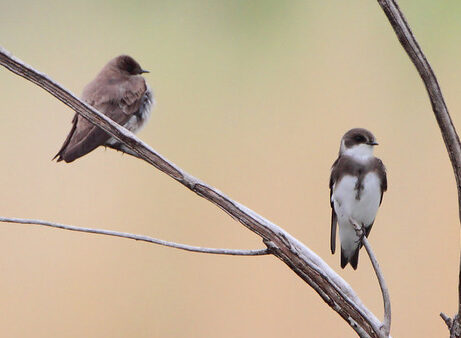
IDENTIFICATION: The Bank Swallow is all brown above (though darker on the wings than on the back and rump) and white below, with a contrasting brown breastband that has a downward projection or “spike” in the center. This leaves its throat clean white, with a white extension curling up behind the brown cheek. (See photo above.) The other all-brown species, the Northern Rough-winged Swallow, has a dingy, “dirty” throat and no breastband; its upperparts are uniformly brown with no contrasts. Some Tree Swallows (females or young) may be gray-brown above, but they are either clean white below or have, at most, a vague, pale breastband without the spike. The Bank’s small size and fluttery flight can also be good clues. Check the pictures in your field guide.
ST. LOUIS STATUS: As stated in more general terms above, Bank Swallows nest locally in our area wherever they can find a sandbank of the right consistency, and thus they may not seem very common—but in spring and especially early-fall migration they can be anywhere, sometimes in the hundreds or even thousands. They don’t stay late; don’t expect to see a Bank Swallow after September.
Learn more and listen to the calls of Bank Swallows here.
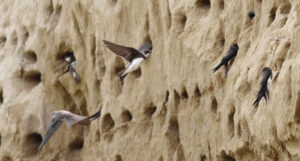

Part of a nesting colony
Part of an August flock. Can you identify a non-Bank swallow here? What is it, and where?
Photo credit: Bill Rowe