
Merlin, Falco columbarius
Bill Rowe
Worldwide, falcons are recognizable by their long, pointed wings, their dashing flight, and their laser focus on pursuing their prey. These qualities have inspired the sport of falconry for millennia, and now they elicit the same fascination among people of all backgrounds who simply enjoy observing birds. North America is home to six true falcons (genus Falco), of which three are commonly seen here in the Midwest: the little American Kestrel, the large Peregrine Falcon, and the Merlin, which is almost as small as a kestrel but more like a peregrine in behavior. A Merlin will appear out of nowhere, bearing down on a flock of birds and causing them either to dive for cover or to bunch up into a tight “flying ball.” Successful or not, with or without its lunch, the Merlin will pull up onto a tree branch or a cornstalk and, with luck, will allow you a few minutes to view it before it takes off again, powering away over the fields and out of sight. Kestrels, by comparison, seem tame as they hover over the grass or scan from power lines for mice and insects—but they are also common and familiar, whereas Merlins preserve more of a mystique by remaining scarce, just the occasional one or two birds in a day (or a month). In Missouri, they are seen fall, winter, and spring, but never as a summer breeding bird. That may change, however: the Merlin’s breeding range has been slowly expanding south from Canada as they adapt to life in towns and cities. They now nest across much of Minnesota and Wisconsin and, within just the past few years, have nested in Iowa cities not that far to our north. The bigger picture is that Merlins occur worldwide around the Northern Hemisphere, with subspecies of varying sizes and colors in Europe and Asia. In western Europe, it is the smallest falcon, since the Eurasian Kestrel is significantly larger than our kestrel. Side note: the name Merlin, originally from French, is one that we adopted from the British when we dropped our former American name for this bird (look under Pigeon Hawk in books before the 1960’s, and while you’re at it, check out Sparrow Hawk, Duck Hawk, and Marsh Hawk).
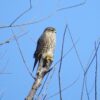
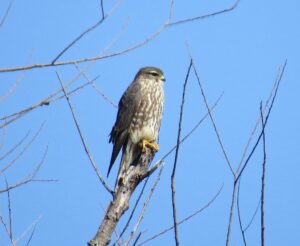
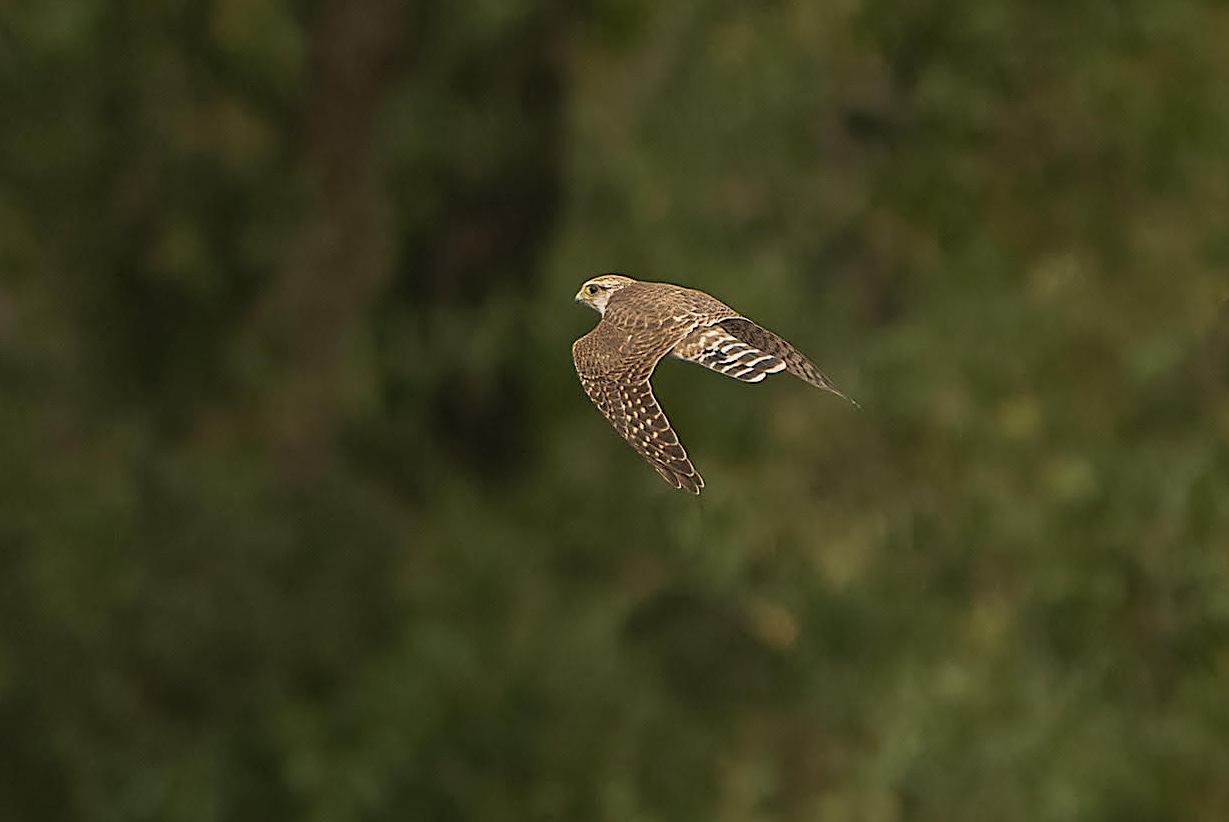
IDENTIFICATION: All Merlins are heavily streaked below and are uniformly colored on the head, back, and wings, either blue-gray (adult males; see banner photo) or brown (females and juveniles; see below); they lack the rufous color on the back shown by all kestrels. Their tails are dark with pale bands, again unlike the rufous tails of all kestrels. Moreover, their faces have a single rather ill-defined mustache or sideburn mark, unlike the double sideburn of a kestrel or the bold contrasty one of the larger peregrine. One additional thing to watch for: If a Merlin is dark above (like the lower left photo), it belongs to the taiga subspecies columbarius, and if it is paler (like the lower right photo) it belongs to the prairie subspecies richardsonii. We see both forms around St. Louis.
ST. LOUIS STATUS: An uncommon migrant, mostly March-April and September-November, with a peak probably in early October; scarcer but increasing in winter.
Learn more and listen to the calls of Merlins here.
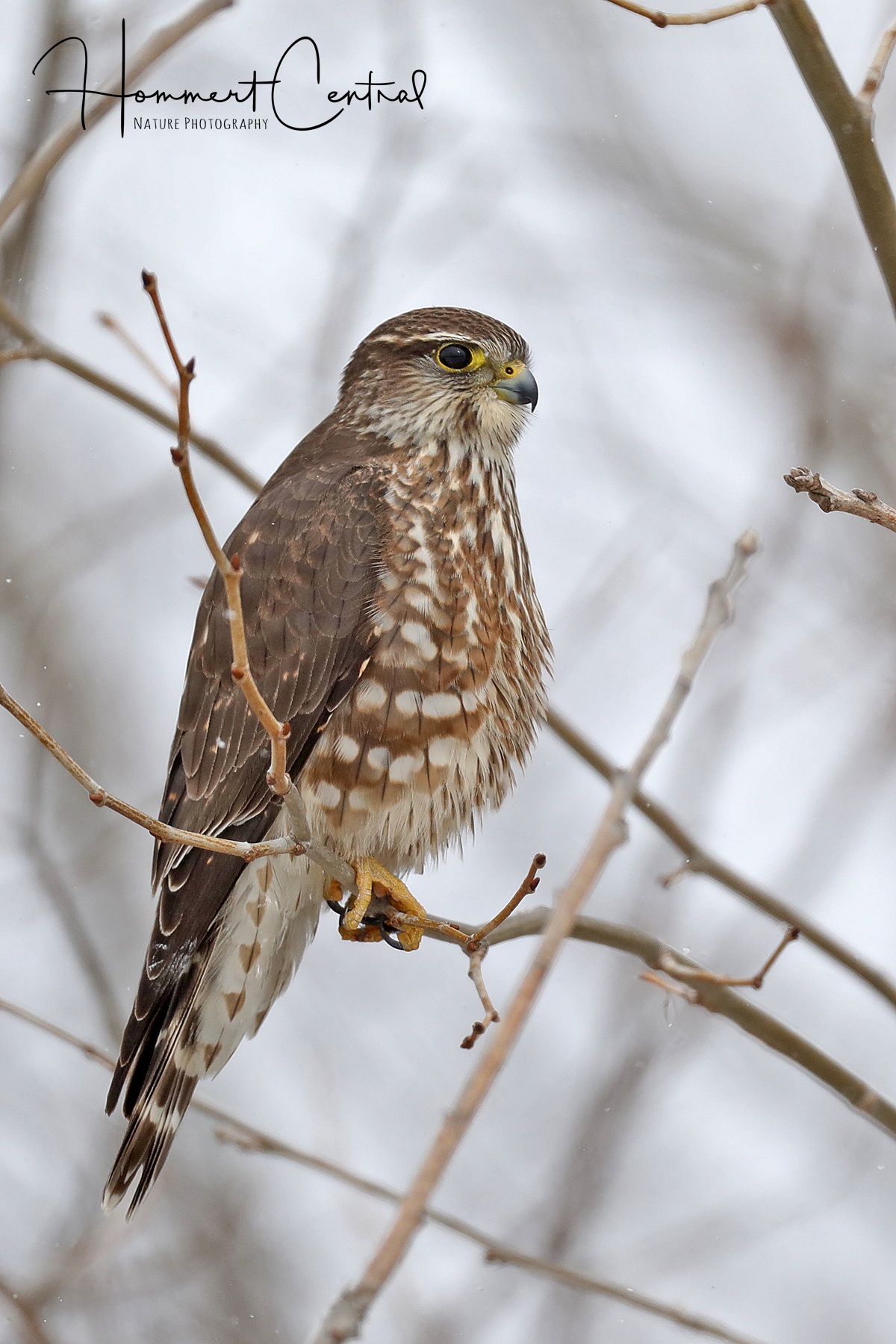
Adult female or immature of either sex; taiga form, dark brown above
Photo Credit: Doug Hommert
Adult female or immature of either sex; prairie form, lighter brown; note black & white banded tail, unlike kestrel or peregrine
Photo Credit: Lisa Saffell