
Savannah Sparrow, Passerculus sandwichensis
Bill Rowe
The Savannah Sparrow could compete for a prize as Most Abundant Bird That No One But Birders Ever Heard Of. It doesn’t nest around here, and the numbers that spend the winter are variable, but during migration it can be one of the most numerous birds out there, potentially allowing you to see scores or hundreds of them if you walk enough fields. And that’s what it takes: walking, or at least driving slowly, and watching the sparrows that flush up from the fields in farmland, parks, and conservation areas. The bird is aptly named if you take “savannah” to mean open, grassy country and don’t worry about the fact that it was named for Savannah, Georgia, by Alexander Wilson in 1811. You will almost surely never see one at your feeder, as they do stick mostly to grassland—but they have no strict requirements, and you can find them in tall dense grass, short bunchy grass, marsh grass, or sometimes no grass at all, on bare ground. Savannah Sparrows occupy a huge breeding range: all of Canada and Alaska along with all or part of 30+ other states and a portion of Mexico. This has led to great diversity in their various regional populations, and to the naming of many subspecies, mostly by ornithologists of earlier eras. This raises the question of what a “subspecies” means, and whether it makes sense to give different names to populations that show only slight average differences in plumage and measurements, and blend into each other through small gradual changes (called “clines”). The current more-or-less-consensus is that a subspecies should be recognizable or “diagnosable,” at least most of the time. One distinctive Savannah subspecies, the pale gray “Ipswich” Sparrow, breeds on Sable Island off Nova Scotia and winters along the Atlantic coast; it used to be considered a full species and was listed as such in older books. In the opposite situation, the “Large-billed” Sparrow of Baja, which wanders north into southern California, might prove to be different enough to be called a full species.
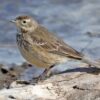
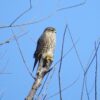
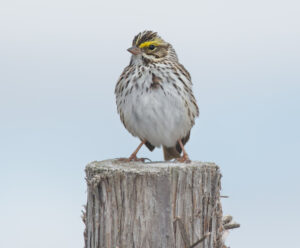
IDENTIFICATION: As just noted, Savannahs are variable: they may be darker or paler, browner or grayer, with anywhere from a lot of yellow on the face to none at all. They are streaked below, often with a central spot, and could be confused with Song Sparrows, but they are smaller with crisper streaking and have a brighter whitish to yellow eyebrow, a white center stripe on the crown, and often white stripes down the back. When in doubt, check the tail. The Savannah has a shorter tail with a notch at the tip, while the Song Sparrow has a longer tail that is blunt or rounded at the tip. Other sparrows such as Vesper could also be a problem, but the distinction from the very common Song Sparrow is the most important to learn first.
ST. LOUIS STATUS: Common to abundant during migration, March-April and October-November; also present in winter more than formerly, sometimes in numbers. Rare as a breeding bird in Missouri; there is a single record of a nesting attempt near St. Louis.
Learn more and listen to the songs and calls of Savannah Sparrows here.


Note short, notched tail; much yellow in face; white stripes on back
Photo Credit: Bill Rowe
Paler bird with no yellow; note fine crisp streaks, white central crown stripe
Photo Credit: Bill Rowe